GPON OLT SFP
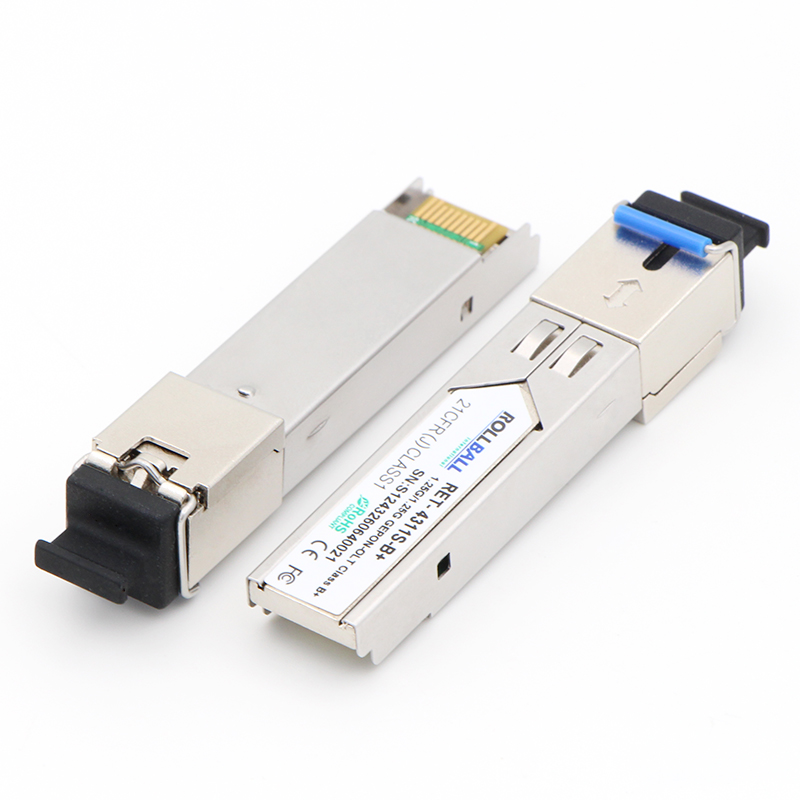
GPON OLT SFP: The Core Transceiver for Fiber Access Networks
In simple terms, a GPON OLT SFP is a standardized, hot-pluggable optical transceiver module that plugs into an Optical Line Terminal (OLT) chassis. Its primary function is to convert the OLT's electrical data signals into GPON-standard optical signals and transmit them over a single fiber to serve multiple end-user premises (up to 64 or 128).
Key Components Explained
GPON (Gigabit-capable Passive Optical Network): The standard (ITU-T G.984) for passive optical networks. It uses a point-to-multipoint architecture with a single fiber from the OLT to a passive splitter, which then serves multiple Optical Network Units (ONUs/ONTs).
OLT (Optical Line Terminal): The telecom central office equipment that aggregates and manages traffic from all connected users. It is the starting point of the GPON network.
SFP (Small Form-factor Pluggable): A compact, industry-standard form factor for optical transceivers, allowing for flexible configuration and easy replacement.
Therefore, GPON OLT SFP = A GPON-standard optical transceiver in an SFP form factor, designed for use in an OLT.
Technical Specifications & Characteristics
1.Standard: Compliant with ITU-T G.984.x series.
2.Wavelengths:
Downstream (OLT to User): 1490 nm (Data & Voice)
Upstream (User to OLT): 1310 nm (User Data)
Optional Third Wavelength: 1550 nm or 1577 nm, commonly used for RF video overlay (IPTV/Cable TV).
3.Data Rate:
Downstream: 2.488 Gbps
Upstream: 1.244 Gbps
(This is the most common asymmetric speed for Class B+/C+ modules).
4.Power Budget & Reach: Determined by the optical class:
Class B+: Up to 28 dB loss budget. Typical reach up to 20 km.
Class C+: Up to 32 dB loss budget. Typical reach up to 30-40 km. More powerful, now the mainstream choice.
5.Splitting Ratio: A single OLT port (one GPON SFP) typically supports a 1:64 or 1:128 split, meaning it can serve 64 or 128 end-users.
6.Fiber Interface: Uses an SC/APC connector (green-colored). The angled polish (APC) minimizes back reflection for better signal integrity.
GPON SFP vs. Standard Ethernet SFP: Critical Differences
| Feature | GPON OLT SFP | Standard Ethernet SFP (e.g., 1G/10G) |
| Protocol | GPON (ITU-T G.984) | Ethernet (IEEE 802.3) |
| Network Topology | Point-to-Multipoint (P2MP) | Point-to-Point (P2P) |
| Core Function | Complex GPON protocol processing (DBA, encryption, OAM) | Simple electro-optical conversion |
| Wavelength | Fixed (1490nm/1310nm) | Various (850nm, 1310nm, 1550nm, CWDM/DWDM) |
| Cost | Higher (more complex functionality) | Generally lower |
| Interoperability | NOT interchangeable. Works only in GPON OLTs. | Interchangeable between compatible switches/routers. |
Critical Note: A GPON SFP will NOT work in a standard Ethernet switch, and a standard Ethernet SFP cannot perform GPON functions in an OLT.
Compatibility & Brands
OEM/Original Brands: Huawei, ZTE, Nokia, FiberHome,Rollball etc., produce modules specifically coded for their own OLTs (e.g., Huawei MA5800, ZTE C300).
Third-Party Compatible Brands: Many reputable optical module manufacturers (e.g., Hisense Broadband, Accelink, Source Photonics) produce high-quality, compatible modules at a lower cost.
The Compatibility Challenge: Many OLTs use vendor locking (checking a unique identifier in the SFP). Third-party modules often work by being programmed with the correct vendor ID and DDM information.
Selection and Deployment Guide
1.Verify OLT Model: Always check your OLT's datasheet or vendor documentation for supported GPON SFP types and compatible brands.
2.Choose Power Class: Select Class B+ for standard deployments or Class C+ for longer reaches or higher split ratios.
3.Ensure Compatibility: When buying third-party modules, explicitly confirm they are tested and guaranteed to work with your specific OLT model and software version.
4.Demand DDM/DOM: Ensure the module supports Digital 5.Diagnostic Monitoring. This allows you to monitor real-time parameters like optical power, temperature, and voltage via the OLT management system—crucial for troubleshooting.
Use Correct Fiber: Always use single-mode fiber (SMF) with SC/APC connectors to connect the GPON SFP to the external splitter.
This is the fundamental way to categorize GPON SFPs, defined by their transmitter power and receiver sensitivity. It determines the link budget (max allowable signal loss) and thus the network's reach and split ratio.
| Class/Model | Standard | Max. Link Budget | Typical Reach | Key Application |
| Class B+ RNT-4321S-B2CD | ITU-T G.984.2 | 28 dB | Up to 20 km | Standard deployments, 1:64 split ratio. The previous mainstream, now largely replaced by C+. |
| Class C+ RNT-4321S-C1PD | ITU-T G.984.2 Amd2 | 32 dB | Up to 30-40 km | Current mainstream. Enables longer reach, higher (1:128) split ratios, or more margin in the fiber plant. |
| Class N1 (sometimes called C++) RNT-4321S-C2PD | Vendor-specific (e.g., Huawei) | ~35 dB or more | > 40 km | Extended reach applications, often for rural or challenging deployments. Not a universal standard. |
Takeaway: For new deployments, Class C+ is the de facto standard choice due to its superior performance margin.
The GPON OLT SFP is the essential "engine" of a FTTH (Fiber to the Home) network. It enables the OLT to communicate efficiently with dozens of users over a single fiber strand using the GPON protocol. Choosing a reliable, compatible, and correctly specified GPON OLT SFP is fundamental for building and maintaining a stable, high-performance broadband access network.

评论
发表评论